Essay · June 24, 2026
The AI Market Is Starting to Price Inference
A Qualcomm Case Study on the Shift from Training Scarcity to Deployment Economics
4134 words · Estimated read time: ~15 mins
For the past two years, the AI trade has seemed obvious.
Larger models demanded more GPUs. More GPUs required more HBM, more networking bandwidth, more data centers, and more electricity, and capital flowed toward whoever enabled that expansion of compute.
NVIDIA became the defining winner, not simply because AI was growing, but because training was the bottleneck. Markets rarely price technology directly. They price whatever constrains its adoption.
Bottlenecks do not stay constant, though, and 2026 looks like the year that became visible in public markets. The shift is not happening because foundation models have stopped improving. It is happening because the limiting factor is no longer how much intelligence we can create, but how efficiently we can deliver it. From 2023 to 2025, valuation leadership accrued almost entirely to the suppliers of frontier-model training: GPUs, HBM, and AI-factory infrastructure. In 2026, the market is increasingly rewarding the companies that sit on the inference path instead, the chips and software that minimize latency, watts, bandwidth pressure, and total cost of ownership at the point of use, whether that point of use is a phone, a PC, a robot, a vehicle, a drone, a camera, or an edge server.
The reason is structural, not sentimental. Training is episodic and capital-intensive; inference is recurring and scales with usage. Once models are good enough, the industry's central question changes. It stops being “who can train the biggest model?” and becomes “who can serve the most useful queries, agent loops, and perception decisions at the lowest latency and cost?”
In 2026 that shift is being accelerated by agentic workflows, AI PCs, robotics, automotive perception, and private, on-device AI, and Qualcomm's recent stock move is the cleanest public-market expression of it, though it is far from the only one. Reuters is now explicitly describing inference and agentic AI as creating fresh opportunities for CPUs and balanced systems, while Intel and Google lean further into CPU and IPU infrastructure built for inference and general compute.1
Qualcomm did not suddenly become an AI company. Instead, AI is beginning to value the problems Qualcomm has spent decades solving: power efficiency, on-device computing, low-latency inference, specialized accelerators, and battery-constrained environments. Qualcomm is the highest-signal case study precisely because it combines all of the relevant vectors in one name, spanning mobile NPUs, AI PCs, automotive, robotics and IoT, on-device runtimes, and now data-center inference. Barron's reported that Qualcomm shares were up 68% over the prior three months as of June 16, 2026, while the Wall Street Journal reported the stock had risen more than 40% after the company disclosed a major custom AI-chip customer, yet the stock still traded at only a little over 20x forward earnings, far below most AI peers.2 The Journal also noted that 57% of Qualcomm's latest revenue still came from handsets, while automotive revenue reached $1.3 billion in the latest quarter, up from $240 million five years earlier.8 That is exactly what a re-rating looks like: the market begins to pay for inference optionality before it is fully visible in segment mix.
The most important analytical distinction underneath all of this is that training economics are dominated by maximum throughput and scale-up infrastructure, while inference economics are dominated by utilization, memory locality, cost per query, and performance per watt under real latency constraints.
NVIDIA's H100 SXM advertises 3,958 INT8 TOPS, 3.35 TB/s of memory bandwidth, and up to 700W TDP; the A100 80GB SXM advertises 1,248 INT8 TOPS, 2,039 GB/s, and 400W TDP, and both remain unmatched for large centralized training and high-end inference.3,25 But at the edge, different economics win. Jetson AGX Orin offers up to 275 TOPS at 15 to 60W with 204.8 GB/s of memory bandwidth14; Hailo-8 offers 26 TOPS at 2.5W and eliminates external DRAM entirely10; Qualcomm's Snapdragon X Elite offers 45 TOPS, up to 135 GB/s of bandwidth, and claims 30 tokens per second on-device12; Qualcomm's QRB5165 robotics SoC offers 15 TOPS, LPDDR5 support, ROS 2 support, and long lifecycle industrial operation13; and Apple's M5 iPad Pro exposes a 16-core Neural Engine with 153 GB/s of memory bandwidth and routes larger requests to Private Cloud Compute only when needed.26,5
The market implication is that inference should command a broader valuation set than training ever did. Training remains concentrated in a handful of platform leaders. Inference spreads value across four layers instead: semiconductors, runtimes, sensors, and domain software. The most attractive investments are therefore not necessarily the biggest training winners. They are the companies that own the recurring decision loop closest to the user, the sensor, or the actuator.4
Why capital markets are re-pricing inference now
I think about this repricing as happening on three overlapping clocks: fundamentals over 3–5 years, narrative over 6–12 months, and stock moves over the last ~2 months.
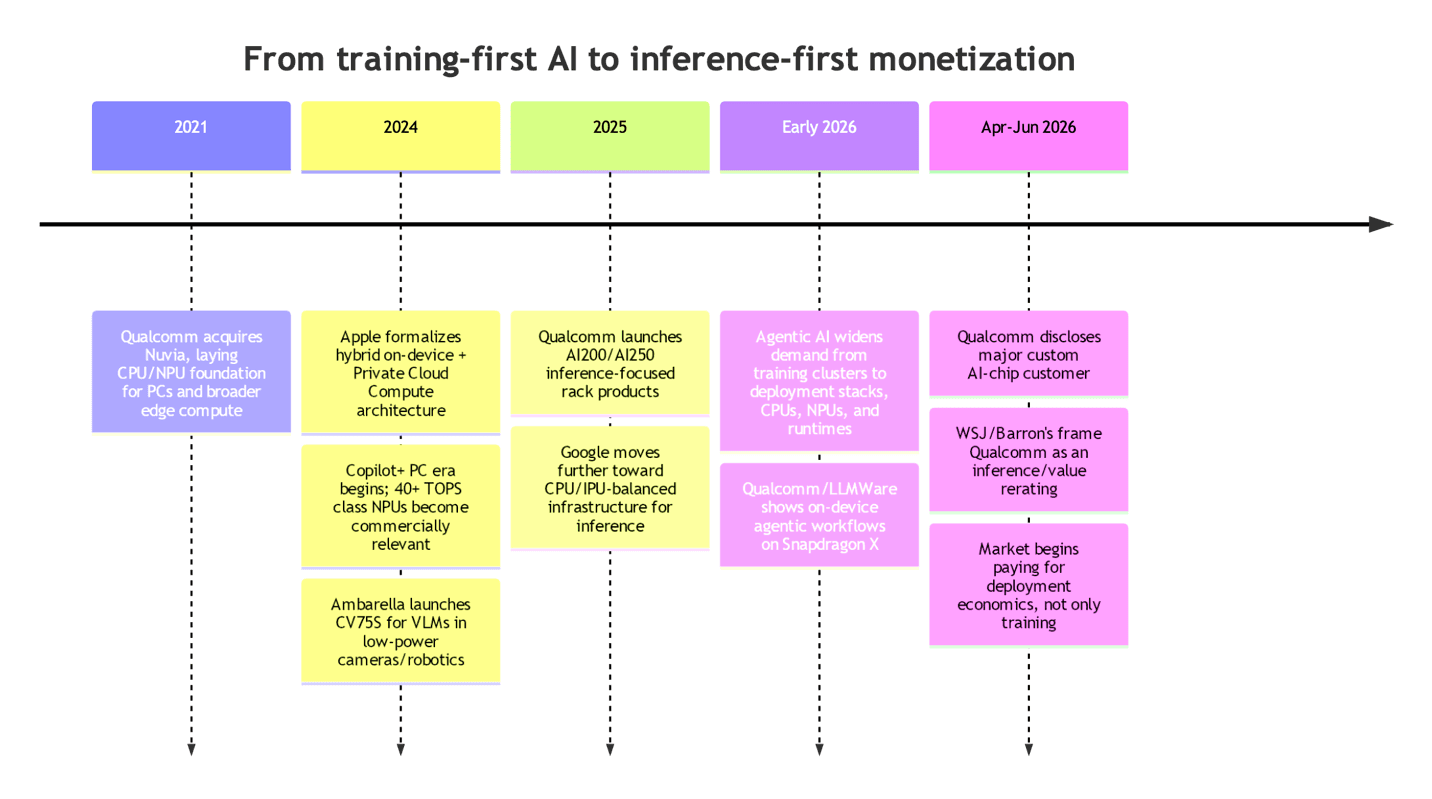
Timeline built from company product and architecture disclosures and recent coverage of the customer disclosure and stock move.
The 3–5 year fundamental clock is about hardware and software readiness quietly being built long before anyone was pricing it. Apple spent years constructing an architecture in which AI runs on-device by default and escalates only when a larger server model is genuinely required; the company says plainly that Apple Intelligence is integrated through on-device processing, and that Private Cloud Compute handles larger requests on Apple silicon while preserving privacy.6,5 Qualcomm, in parallel, spent that same stretch building the AI Hub, AI Stack, and AI Engine Direct ecosystem for on-device deployment across mobile, compute, automotive, IoT, and cloud.4 Ambarella specialized in low-power vision silicon over the same period, and Hailo built a memory-centric edge-inference story that avoids external DRAM altogether.10 None of this is a new story. It is the installed base that made the late-2025 and 2026 narrative shift possible.
The 6–12 month narrative clock is about agents and compound AI systems. Once AI stops being a one-shot chatbot and becomes a multi-step tool user, the bottleneck broadens well beyond training GPUs. Salesforce-style compound systems reported more than 50% lower P95 latency, up to 3.9x throughput improvement, and 30 to 40% cost savings from architecture designed specifically for modular inference serving.7 Qualcomm and LLMWare made the same point on-device in May 2026, showcasing local, scheduled, multi-step enterprise workflows on Snapdragon X and explicitly pitching token cost savings, privacy, and performance per watt.20 Reuters, in turn, described inference and agentic AI as reopening opportunity for CPUs and balanced infrastructure, not just GPUs.1
The recent ~2 month stock clock is where public markets visibly changed their mind. The Philadelphia Semiconductor Index was reported up 59% in 2026 by Reuters on May 6.1 Qualcomm then became the emblematic inference re-rating stock: Barron's said it was up 68% over three months as of June 16, and the Journal said it was up more than 40% after the company disclosed a major AI customer.2,8 That is not merely enthusiasm about AI in the abstract. It is specifically the market paying for deployment monetization in a former mobile chip name.
The economics of inference versus training
Training and inference share the same broad hardware stack, but they are built to maximize almost opposite objective functions, and that difference is really the whole thesis in miniature.
Training economics remain dominated by massive accelerators and interconnect. NVIDIA's H100 (SXM lists 3,958 INT8 TOPS, 80 GB of HBM, 3.35 TB/s of memory bandwidth, up to 700W TDP, and 900 GB/s of NVLink) and the A100 (80GB SXM lists 1,248 INT8 TOPS, 80 GB of HBM2e, 2,039 GB/s of memory bandwidth, and 400W TDP) class chips are ideal for training and large centralized serving because they maximize raw throughput and scale-up bandwidth.
Inference economics, by contrast, increasingly reward right-sized compute rather than maximum compute. Qualcomm's Cloud AI 100 Ultra inference study showed that for some 70B-parameter models, a single QAic card could operate where eight A100 GPUs were required in that environment, at 20x lower power consumption, 148W versus 2,983W. For smaller models, single QAic devices achieved up to 35x lower power consumption than a four-GPU A100 configuration, 36W versus 1,246W.9 The implication is not that A100 and H100 class chips lose relevance. It is that inference demand naturally fragments into many workload tiers, and public markets are starting to price the chips that win the lower total-cost-of-ownership tiers separately from the chips that win frontier training.
Memory is the hinge variable running underneath most of this. In training, large HBM pools and interconnect dominate. In inference, the critical question is often simpler and more mechanical: can the system keep the model and the KV cache working set close enough to compute without excessive external memory traffic? Hailo's product narrative, built around eliminating external DRAM entirely, is effectively a capital-markets thesis in disguise: the company argues directly that memory integration reduces cost, complexity, and supply-chain risk.10 Ambarella makes a similar point from the vision side, pitching its CV75S family as enabling vision-language models and advanced image processing inside cost- and power-constrained devices.18
Latency, meanwhile, matters more than raw TOPS in most real deployment settings. On Snapdragon X Elite, an end-to-end on-device RAG system running on the Hexagon NPU delivered 18.1x faster prefilling, 4.0x lower end-to-end query latency, and 4.0x less energy than the CPU baseline, while the integrated GPU was actually 1.7x slower than the CPU and used 6.5x more energy than the NPU for that workload.11 That single result is close to the whole argument for why inference gets re-priced into NPUs and runtimes rather than only datacenter GPUs: users pay for responsiveness and battery life, not for datacenter-scale peak FLOPS.
Qualcomm underscored where this is heading in June 2026, agreeing to acquire Modular, the AI-native software company behind the MAX inference platform and the Mojo language, specifically to build a silicon-agnostic compute layer that runs models across CPU, GPU, NPU, and custom ASIC architectures without rewrites for each accelerator.27 That is close to a confirmation, in acquisition form, that inference value increasingly sits in the software layer that turns silicon into usable performance per watt, not only in the chip itself.
Catalysts and unit economics across devices
The clearest catalysts for inference re-pricing in 2026 are Qualcomm's customer disclosure, AI agents, AI PCs, robotics, and automotive. Each one of them widens the surface area of recurring inference spend a little further.
Qualcomm customer disclosure
Qualcomm's shares rose more than 40% after it disclosed a major custom AI-chip customer, and Barron's framed the market as looking ahead to investor-day disclosure around the company's custom AI chip strategy, with J.P. Morgan modeling >$3 billion in data-center revenue by fiscal 2027 and potentially $35 billion by fiscal 2031.8,17 The important thing is not just the absolute number. It is that the market began revaluing Qualcomm from a mobile handset semiconductor company into an inference silicon platform with credible datacenter attach.
AI agents
Agentic AI increases the number of inference events per user task, full stop. Salesforce's production study showed that inference architectures optimized for compound systems can materially reduce latency and cost, and Qualcomm's May 2026 LLMWare blog translated that directly into a device thesis, pitching private, local, scheduled, no-code enterprise workflows on Snapdragon X and calling out measurable ROI and token cost savings.7,20 Markets are beginning to pay not only for model quality, but for the silicon and software that service these repeated loops efficiently.
AI PCs
AI PCs are the first mainstream proof that NPUs are becoming monetizable product differentiation rather than a box to check. Qualcomm's Snapdragon X Elite advertises 45 TOPS, up to 135 GB/s bandwidth, and 30 tokens per second of on-device generative AI; the newer X2 tier advertises 80 to 85 TOPS with 152 to 228 GB/s bandwidth depending on the SKU.12 Apple's current M5 iPad Pro tech specs list a 16-core Neural Engine and 153 GB/s of memory bandwidth, and Apple says developers can use on-device Foundation Models whose features work offline and are available at no cost per request, which is a genuinely powerful statement about unit economics.26,6
On Snapdragon X Elite specifically, the economics are no longer hypothetical. The NPU-RAG paper showed 9.1x higher embedding throughput and 12.3x less system energy for indexing versus CPU, alongside the query-stage latency and energy results discussed above, and that is an investment-grade datapoint because it ties the NPU directly to lower system cost and better user experience for a realistic multi-model workload rather than a synthetic benchmark.11
Robotics
Robotics makes inference economics explicit in a way nothing else quite does, because the latency budget there is physical rather than experiential. Qualcomm's QRB5165, a robotics-focused SoC, is built around 15 TOPS of on-device AI, LPDDR4x and LPDDR5 support, ROS 2 and Linux support, and a long lifecycle with industrial temperature capability, and Qualcomm positions it for consumer, enterprise, industrial, and defense robots and drones.13 That is a deployment platform for inference, not a training platform. NVIDIA's Jetson AGX Orin makes the same market point from a different angle, offering up to 275 TOPS, 204.8 GB/s of bandwidth, and operation from 15W to 60W.14 Training GPUs do not disappear from robotics; they move upstream into simulation and centralized model development. But the monetization point in the field is a local inference SoC with predictable thermal behavior and sensor fusion.
Automotive
Automotive is one of the strongest public examples of inference monetization, because the workloads there are persistent, safety-adjacent, sensor-rich, and localized by nature. The Journal reported Qualcomm's automotive revenue reached $1.3 billion in the latest quarter, up from $240 million five years earlier.8 Ambarella's latest results commentary highlighted a record high in automotive revenue driven by AI penetration in commercial vehicles, and said customers were seeking broader relationships across edge infrastructure and robotics.23 Hailo, meanwhile, emphasizes automotive-grade operation, AEC-Q100 compliance, and ASIL-oriented positioning for its edge AI chip.10 The investment significance is that automotive inference is sticky in a way cloud training spend never has been. Vehicle compute attaches to long design cycles and embedded software stacks, which makes the revenue less bursty and, once designed in, considerably more durable.
Unit economics by device class
The clearest new pattern shows up in phones and wearables, where the governing constraint is battery life and thermal envelope rather than raw compute. Qualcomm's recent wearable announcement said its Hexagon NPU can handle 2 billion parameters at 10 tokens per second on-device, while a UC Riverside and Qualcomm study summarized by Axios found that on-device AI can reduce power use by roughly 90% per query versus cloud, albeit with slower response time. In phones, the economic trade is often slightly slower but dramatically cheaper, more private, and local.
The same pattern holds across PCs, robots, and vehicles: the binding deployment constraint, whether that's battery, latency, power envelope, or lifecycle durability, determines which chip wins, not raw training-scale compute. XR and smart cameras follow the same edge-locality logic, which is why both Qualcomm's AI Stack and Ambarella's camera SoCs are built cross-platform rather than for a single device class.
Ecosystem map and likely winners
The inference market is broader than the training market because value distributes across silicon, runtime, sensors, and vertical workflow ownership. That is why capital markets can re-rate multiple layers at once.
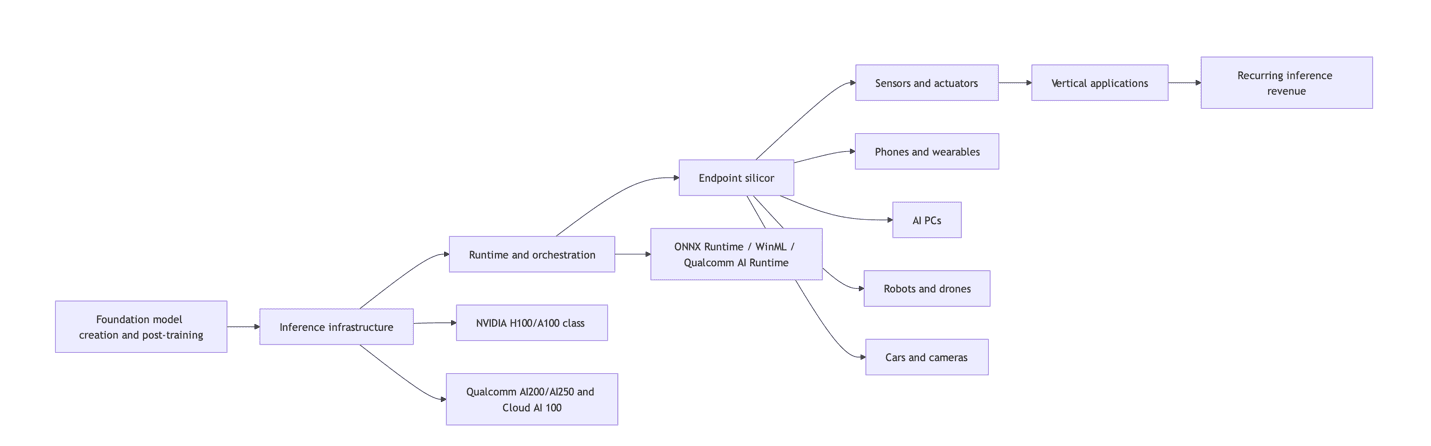
M&A scenarios, investment theses, and signals to watch
Likely partnership and M&A scenarios
The clearest scenario is no longer speculative. On June 24, 2026, Qualcomm agreed to acquire Modular, the AI-native software company behind the MAX inference platform and the Mojo language, founded by Chris Lattner. The stated rationale is a direct match for this thesis: Qualcomm wants a silicon-agnostic compute layer that lets developers write once and run across CPU, GPU, NPU, and custom ASIC architectures, improving performance per watt and giving customers real choice in how and where they deploy AI, from device to data center.27 This is the strategic logic behind Qualcomm's datacenter push made explicit through acquisition rather than product marketing, and it strengthens the case that the winners of this cycle are being built at the software and runtime layer as much as at the chip layer.
A second, related scenario is deeper Qualcomm and Microsoft alignment around AI PCs and local agent workflows. Qualcomm's recent LLMWare example explicitly plugs into Microsoft Foundry Local, which is exactly the kind of co-sell and developer-distribution relationship that can accelerate inference adoption without requiring an acquisition.20,19
A third, still-speculative scenario is Qualcomm and Tenstorrent. Barron's reported Qualcomm was in discussions to acquire Tenstorrent for $8 to $10 billion.21 If such a deal were completed, the rationale would be straightforward: strengthen datacenter and custom AI capabilities and bring more architectural depth into the inference-server push. This remains unannounced, but taken together with the Modular acquisition, it is consistent with a company deliberately building out the software and compute-architecture depth behind its inference silicon story.
A fourth scenario is continued takeout pressure on niche edge-AI specialists. Ambarella's strategic value is unusually clean: low-power vision silicon, automotive attach, robotics adjacency, and camera and sensor expertise. Earlier reports said it was exploring a sale.22 Whether or not that particular process resumes, the broader logic remains: specialized edge-inference assets are more valuable once markets price inference separately from training.
Three investment theses
The first thesis is that Qualcomm is the cleanest public inference-optionality stock. The core of the thesis is not that Qualcomm will beat NVIDIA in training. It is that Qualcomm's installed base and software stack allow it to monetize inference across the widest mix of endpoints, and the stock still trades like a partially skeptical market. The recent rally signals that markets have begun to recognize this, but the Journal's valuation framing implies the re-rating is incomplete if execution follows.8
The second thesis is that edge-vision specialists are the most under-owned second-order beneficiaries. Ambarella and Hailo-like architectures win where models meet cameras, robots, industrial systems, and commercial vehicles. Their advantage is not the largest model support; it is running the right model at the right latency inside a brutal power envelope. That is where inference becomes economically sticky.
The third thesis is that the next leg of AI upside will rotate into runtimes and balanced systems. Reuters' CPU and inference coverage, Intel and Google's CPU and IPU expansion, and Qualcomm's deployment tooling all point the same way: once the frontier-model buildout phase matures, system value shifts toward orchestration, distribution, and endpoint utilization. In other words, the market may increasingly reward tokens per watt and per dollar rather than just FLOPS per rack.
Signals to watch
The most important signal is whether Qualcomm converts the narrative into disclosed datacenter revenue and named deployments over the next two to four quarters. That would turn a valuation story into a segment story.
The second signal is AI PC usage, not shipments. The real question is whether local workflows, retrieval, summarization, perception, personal agents, and enterprise copilots become default behavior on-device. Papers and demos already show the cost and latency benefits; usage will determine the revenue slope.
The third signal is robotics and automotive attach. If robot OEMs, drone makers, and automotive suppliers keep broadening their silicon and runtime relationships, that is evidence that inference is moving from demo to design-in. Ambarella's commentary about broader customer relationships in robotics and edge infrastructure is worth monitoring closely.23
Technical appendix: Representative chip comparison
| Chip / Platform | AI Perf | Power / TDP | Memory / BW | Typical Workloads | Takeaway |
|---|---|---|---|---|---|
| Qualcomm Snapdragon X Elite | 45 TOPS NPU; up to 30 tokens/s on-device | Not disclosed | LPDDR5x, up to 135 GB/s | AI PCs, local RAG, copilots | Best evidence client NPUs are crossing from feature to utility |
| Qualcomm Snapdragon X2 | 80–85 TOPS (SKU-dependent) | Not disclosed | Up to 228 GB/s | Higher-end AI PCs, local agents | Raises the inference ceiling on PCs meaningfully |
| Qualcomm QRB5165 | 15 TOPS | Not stated | LPDDR4x/LPDDR5 | Robots, drones, industrial | Pure expression of embodied inference economics |
| NVIDIA Jetson AGX Orin 64GB | Up to 275 TOPS INT8 | 15–60W configurable | 64 GB, 204.8 GB/s | Robotics, edge servers, AV/industrial | Strong benchmark edge platform; more power-hungry than ultra-edge NPUs |
| NVIDIA H100 SXM | 3,958 INT8 TOPS | Up to 700W | 80 GB, 3.35 TB/s | Datacenter AI factories | Training/reference apex; not the only inference winner |
| NVIDIA A100 80GB SXM | 1,248 INT8 TOPS | 400W | 80 GB, 2,039 GB/s | Datacenter AI | Benchmark from which lower-power alternatives are differentiated |
| Apple M5 Neural Engine | 16-core (TOPS undisclosed) | Not separately disclosed | 153 GB/s (iPad Pro) | Personal AI, local text/image | Cleanest hybrid private-inference architecture in consumer computing |
| Ambarella CV75S | 3x prior-gen (CVflow 3.0) | Low-power emphasis | Not disclosed | Smart cameras, robotics, edge vision | Monetizes inference where cameras are the endpoint |
| Hailo-8 | 26 TOPS | 2.5W typical | Integrated, no external DRAM | Cameras, industrial, automotive | Strongest proof that memory-local edge inference can be dramatically more efficient |
Approximate advertised perf/W comparison
This chart uses publicly disclosed AI throughput divided by published power/TDP where both were available. It is illustrative only; cross-chip TOPS per watt is not apples-to-apples across form factor, precision path, software stack, and workload. Datacenter GPUs dominate absolute throughput.
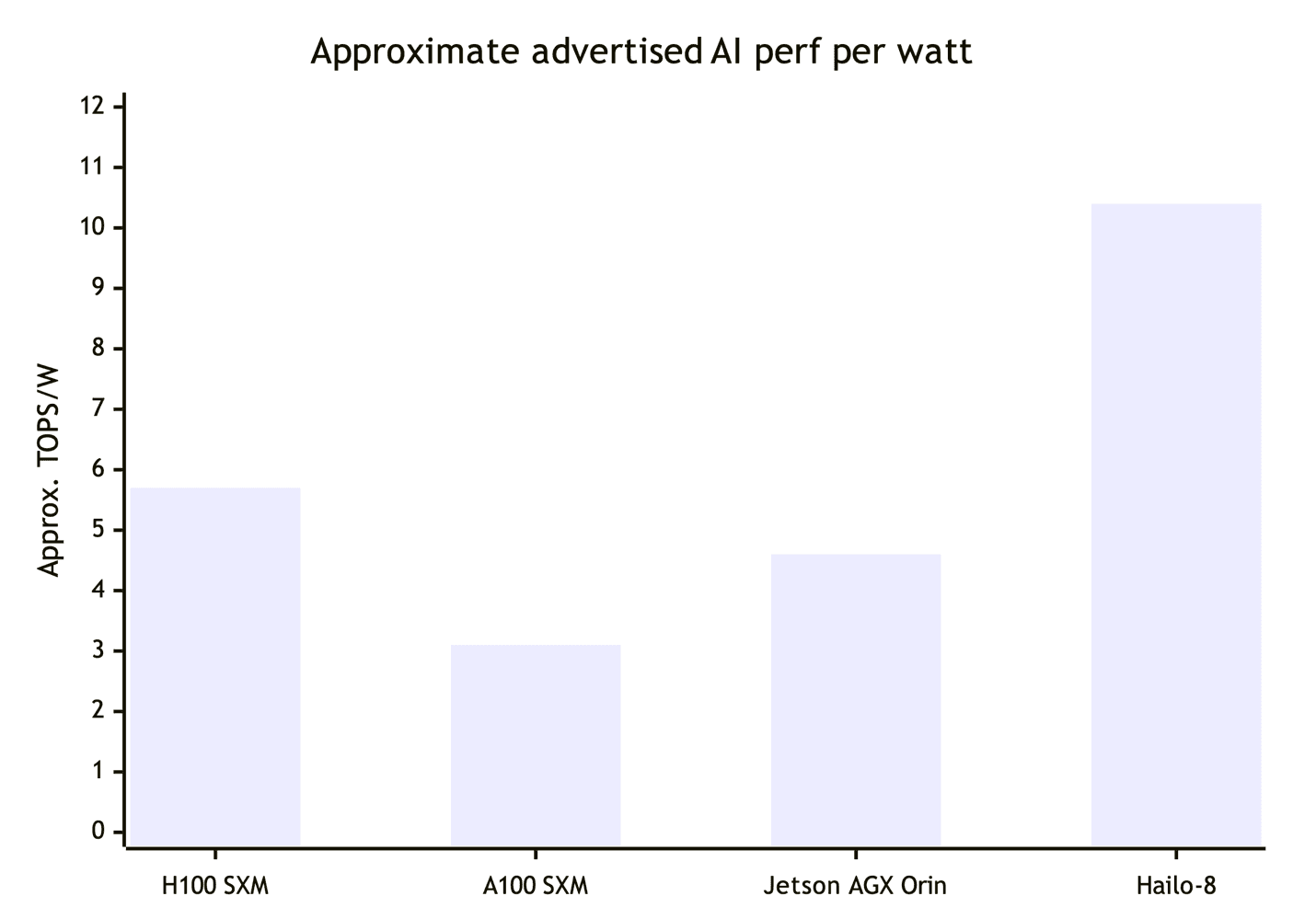
Edge-focused chips often dominate throughput per watt in the deployment tiers where that metric matters most. That is why capital markets are starting to price inference separately from training.
Open questions and limitations
Some figures in this report are back-solved approximations from percentages reported by Barron's and the Journal rather than a direct exchange time series. The directional conclusion is high confidence; the exact intraperiod price path is not the point.
I was able to ground product, architecture, and benchmark claims primarily in company pages and academic and technical papers, but I did not retrieve direct EDGAR line references for Qualcomm's latest filing in this sourced set. For revenue mix and automotive segment scale, I relied on recent WSJ reporting rather than a quoted filing table. Those numbers are still highly relevant, but should be treated as secondary-source summaries of the latest quarter.
Apple's current official product pages emphasize Neural Engine cores, memory bandwidth, and deployment architecture, but not current TOPS figures in the lines retrieved here. Accordingly, the Apple row prioritizes what Apple currently discloses directly.
Even with those limitations, the core conclusion is robust: 2026 marks a visible capital-markets transition from pricing frontier training scarcity alone to pricing recurring inference economics across the deployment stack. Qualcomm's move is the most visible stock-market signal, but the underlying evidence spans product launches, runtime tooling, academic benchmarks, and system-level partnerships across PCs, phones, vehicles, robotics, and edge cameras.
Sources
- 1.AMD shares hit record high, spark global chips rally on AI demand optimism — Reuters
- 2.Qualcomm Stock Shakes Off Smartphone, PC Fears as AI Chip Excitement Grows — Barron's
- 3.H100 GPU | NVIDIA
- 4.Qualcomm AI Hub
- 5.Private Cloud Compute: A new frontier for AI privacy in the cloud — Apple Security Research
- 6.Apple Intelligence and Siri — Apple
- 7.Scalable Inference Architectures for Compound AI Systems: A Production Deployment Study
- 8.Qualcomm Is a Rare AI Chip Value Play — WSJ
- 9.Serving LLMs in HPC Clusters: A Comparative Study of Qualcomm Cloud AI 100 Ultra and NVIDIA Data Center GPUs
- 10.AI Accelerator Hailo-8 For Edge Devices | Fully Integrated Memory
- 11.Energy-Efficient On-Device RAG on a Mobile NPU: System Design and Benchmark on Snapdragon X Elite
- 12.Snapdragon X Elite | Best Laptop Performance | Snapdragon
- 13.Qualcomm Dragonwing QRB5165 | Robotics CPU with AI & 5G | Qualcomm
- 14.Jetson AGX Orin for Next-Gen Robotics | NVIDIA
- 15.Qualcomm's new chip is geared toward wearable AI gadgets — The Verge
- 16.AI Stack Developers | Developer-Centric Platform | Qualcomm
- 17.Qualcomm Stock Soars on New AI Servers Meant to Compete With Nvidia and AMD — Barron's
- 18.Ambarella's Latest 5nm AI SoC Family Runs Vision-Language Models and AI-Based Image Processing With Industry's Lowest Power Consumption — Ambarella
- 19.Shop High-Performance Laptops, Computers, PCs, and Tablets | Microsoft Windows
- 20.LLMWare.ai on PCs with Snapdragon X Series — Qualcomm Developer Blog
- 21.Qualcomm Is Eyeing a Massive AI Pivot. Why Wall Street Is Still Cautious. — Barron's
- 22.Ambarella's Stock Pops 20% as the Chip Designer Reportedly Mulls a Sale — Investopedia
- 23.Edge AI Chipmaker Ambarella Narrowly Tops Q1 Estimates — Investor's Business Daily
- 25.NVIDIA A100 | NVIDIA
- 26.iPad Pro - Technical Specifications — Apple
- 27.Qualcomm to Acquire Modular — Qualcomm